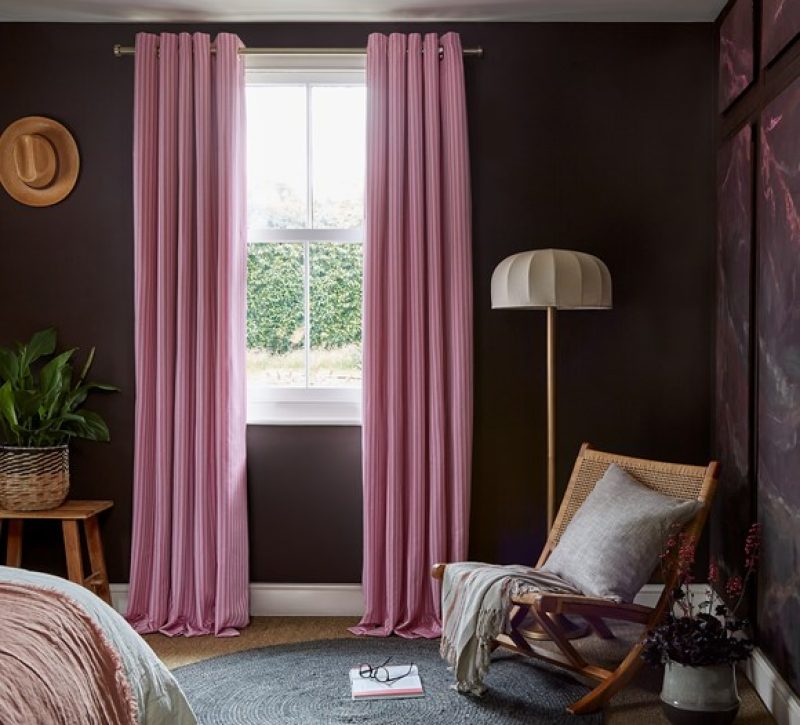
Before choosing your curtains, check where the hem will sit when they are drawn closed. If your window sits above a radiator, a lovely pair of curtains can get in the way of heating the room.
But don’t despair; this doesn’t mean you can’t have curtains. A curtain with a shorter drop will keep the radiator exposed, or you could keep full-length curtains at the sides and use a blind for evening privacy.
As you start closing the curtains earlier and using the heating more often, check that the fabric stays clear of the radiator.
Should curtains cover a radiator?
Ideally, curtains should leave a working radiator uncovered. Radiators transfer heat into the room partly by warming the surrounding air. Fabric hanging across the front or over the top can interfere with that circulation, leaving warmth trapped between the curtain and the window.
Heavy curtains can be very useful for keeping heat inside your room, as long as you keep them clear of the radiator. This way, warm air can circulate into the room rather than rising behind the fabric towards the glass.
Check how far the radiator projects from the wall and where the pole or track holds the fabric. Together with the curtain length, these measurements determine whether the curtains will hang in front of the radiator or stay clear of it.
What length should curtains be above a radiator?
Many people opt for sill-length curtains. They dress the window nicely while leaving the radiator below it exposed. A slightly longer drop may also work if there is enough space between the sill and the radiator.
Avoid choosing a standard “below-sill” length without checking it against your own window’s measurements. In one room, that might leave plenty of clearance. In another, the hem could cover the radiator’s top grille.
Can I still have full-length curtains?
Yes. You can keep full-length curtains open beside the window while the heating is on.
Add a blind for privacy after dark, and the curtains can stay drawn back. You still get the colour, texture and long folds of fabric, while the radiator remains uncovered.
Check that the gathered curtains fit beside the radiator without covering either end. If the radiator extends beyond the window, you may need to draw the curtains further back, which requires more wall space and a longer pole or track.
If you want to close the curtains every evening, a shorter drop may be the better choice for this particular window.
Should I choose blinds if there is a radiator under my window?
A blind can be an easier fit because it covers the glazing without needing to extend down the wall.
If you like the soft folds and fabric of a curtain, you could install a Roman blind. If your primary reason for choosing blinds is for heat efficiency, you could look at an insulating blind. Either can be a better alternative to full-length curtains that cover the radiator.
For a blind mounted outside the recess, measure where its bottom edge will sit when fully lowered. It should stay clear of the heater. For inside the recess, check that handles won’t catch the blind and that it can be raised out of the way when you open the window. (Sounding complicated? Not to worry – we can help).
Can I combine blinds with curtains?
Using blinds as well as curtains is a great solution for some homes, particularly if you like to see the softness of fabric around your window.
The blind handles privacy and light control. The curtains frame the window and stay open while the radiator is in use. Choose a blind fabric that gives you the privacy you need after dark, since a sheer fabric alone may not be suitable.
Our guide to layering blinds and curtains goes into more detail about how to combine the two.
Are curtains better than blinds for insulation?
It depends. Fabric, lining, construction and fit all affect how a window covering performs. Thick lined curtains can help reduce heat loss, while cellular blinds use pockets of air within their honeycomb structure to provide an additional insulating layer at the window.
Should I tuck curtains behind the radiator?
We wouldn’t recommend using this as your everyday solution. It pushes fabric close to the heat source and may obstruct airflow, depending on the arrangement.
Keep the thermostatic radiator valve clear too. This is usually the numbered control at one end of the radiator. A valve with a built-in temperature sensor needs air to circulate around it. If curtains enclose it in a warm pocket, it may reduce the radiator’s output before the rest of the room feels comfortable.
Overall, a suitable curtain length or a different combination of window coverings is a more practical solution than rearranging the hem every evening.
What if I have electric heaters?
Electric radiators, panel heaters and storage heaters have their own clearance requirements. Follow the instructions for your specific model, including the space needed above, in front and at the sides.
Don’t assume that a curtain position suitable for a central-heating radiator is suitable for an electric heater. Fabric must not cover the heater or obstruct its outlets. If you are unsure about the required clearance, check with the manufacturer before deciding on your curtain drop or blind position.
We can help you choose
During a home consultation, we measure the window and check the radiator, sill and space at either side. You can compare fabrics and linings, see how the different options would fit, and decide between manual or motorised controls.
At Knights Blinds, we supply and fit both blinds and curtains. If you prefer curtains, we can help you choose a suitable drop. If a blind would leave more space around your radiator, we can show you options for that too.
Visit our showroom in Rochester to see the range, or book a free home consultation for advice on your windows.